

It’s early days for the technology, but many packaging leaders say they intend to use generative AI in the near future. Nestlé, Colgate-Palmolive and more peel back the curtain on their AI efforts.
In Nestlé’s R&D department, a tool is identifying entirely new kinds of high-barrier packaging materials. It’s generative AI.
A growing number of consumer packaged goods companies are starting to deploy artificial intelligence in their packaging design processes. So too are packaging manufacturers exploring how the technology can save time and resources in design and manufacturing.
Nestlé’s researchers feed public and proprietary documents into a knowledge base. Then, they fine-tune the data using a transformer, together with IBM Research, to understand how molecular features in packaging correlate to physical properties. Finally, the AI-based model analyzes the inputs within the set parameters.
“It can identify appropriate materials that are suitable for protecting dry and sensitive foods such as coffee from moisture, temperature swings and oxygen,” a Nestlé spokesperson said via email.
While the use cases are nascent, AI is catching on. A 2024 McKinsey survey of more than 200 paper and packaging executives found that 95% said they believe their companies should invest in generative AI. And 77% said their firms have moderate to strong intentions to use gen AI in the near future.
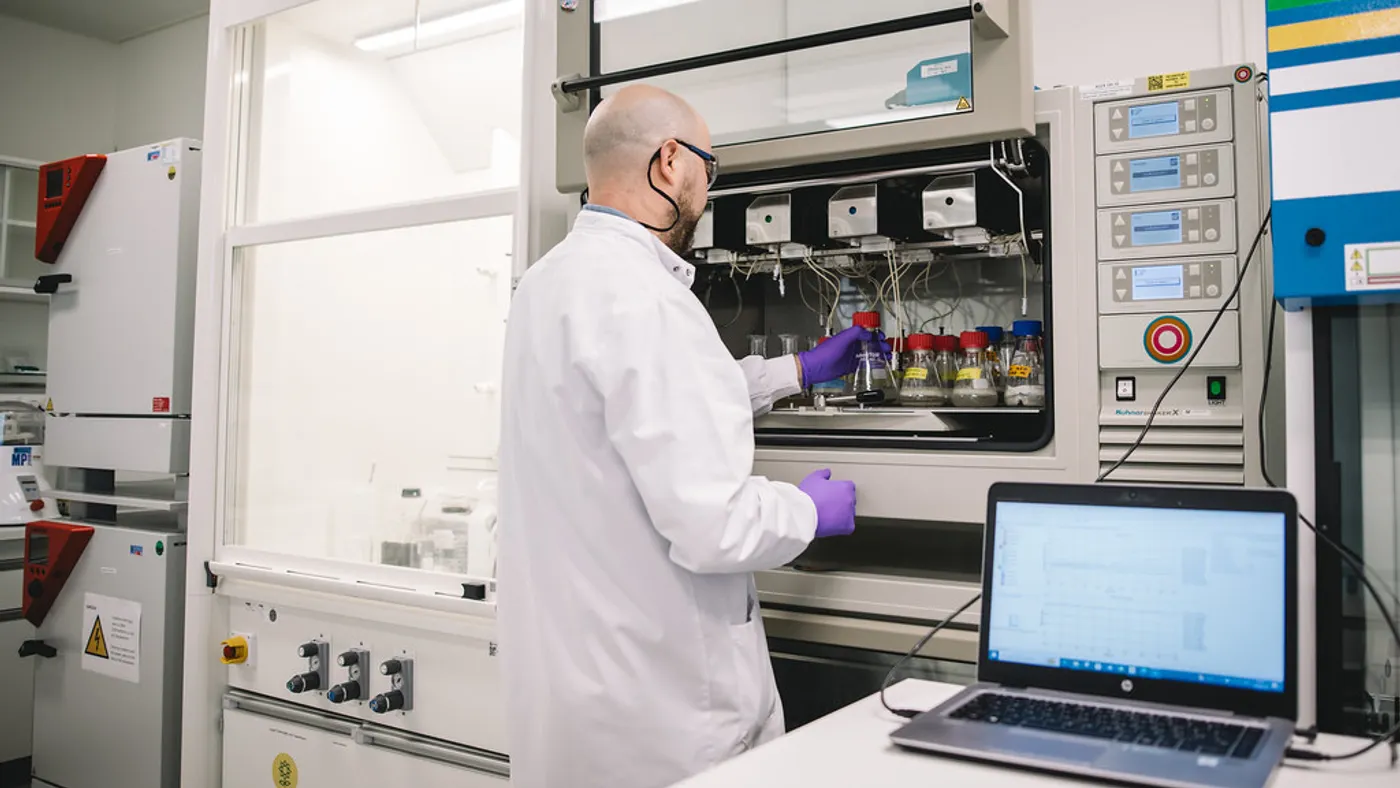 Image credit: Permission granted by Nestlé Research & Development to Packaging Dive.
Tom Egan, vice president of industry services for the Association for Packaging and Processing Technologies, or PMMI, sees “a pretty enthusiastic acceptance” of AI in the industry. He said applications range from logistics to sales and marketing to manufacturing.
Here are some of the processes in which packaging companies and CPGs are starting to use AI.
One of the notable potential benefits of AI — and among the biggest use cases being explored today — is the ability to assess packaging modifications or updates in a virtual environment.
When a client requests a new design from flexible packaging provider Tradepak, the company inputs the customer’s parameters into its systems, said President Rafael Recao. AI can rapidly pull from databases, synthesize data points, and deliver design and substrate recommendations. Then, packaging leaders make a final decision.
With simulation models and digital twins, AI can look at form factors, examine touch points and predict consumer reactions to quickly generate 10 mockups of a SKU’s packaging, Egan said, rather than physically making and testing each version.
AI can “analyze this unbelievably large number of data points and provide you with insights,” Egan said, adding that packaging leaders can refine the options from there.
Simulation models can also help to design packaging for the same product in different channels, such as one version for retail shelves and another for e-commerce. AI could determine the best design and protective properties for each channel while ensuring brand consistency, Egan said.
Colgate-Palmolive is exploring how simulations could validate new designs for components such as bottles, caps and spray pumps, said Sukhdev Singh Saini, global toothbrush and devices packaging lead at the company.
Without AI, “we have to physically make a lot of samples to test,” Saini said. Then, the samples have to be shipped, tested and possibly altered before being sent out for another round of testing. “There is a lot of time involved, a lot of material involved.”
With a simulation model, though, the CPG feeds specs into a system, and AI replicates testing to provide results. Saini acknowledged the tech is still a work in progress and not a 100% replacement just yet.
Jonathan Garini, CEO and enterprise AI consultant at Fifthelement, sees brands using algorithms to simulate how a substrate performs in real-life conditions like humidity or rough handling.
“This not only accelerates the test cycle but also can lower the cost of physical prototyping significantly,” Garini said.
Recao said Tradepak uses Adobe Illustrator equipped with AI to make adjustments on colors, design placement and other elements before printing.
For artwork, Colgate-Palmolive works with Esko software, which uses automation throughout the packaging go-to-market process. The use of AI in artwork management has improved quality while saving time, Saini said.
Without the system, the CPG would have to individually search previous artwork details to make even minor modifications. But now, the person who manages artwork can receive data in minutes and make decisions more efficiently. In a major run of 50 or more SKUs, Saini said Colgate-Palmolive has cut down the development time by 60% to 70%.
Colgate-Palmolive has partnered with Glacier on an AI-based system for sorting toothpaste tubes at recycling facilities. The CPG can view a dashboard that shows toothpaste tube materials and their recyclability, along with tube recycling behavior in various cities.
With more states adopting extended producer responsibility programs, Saini anticipates “a lot of work being done on recyclability.”
Another generative AI use case that McKinsey noted in its report is to enhance visual inspection systems for waste, in order to improve the quality of recycled paper and cardboard.
Many CPGs use computer vision, optical systems and imaging technology on production lines. It’s not a new phenomenon, but machine learning is “taking it a couple of notches up” with AI-based features that improve quality management systems, Saini said.
At Nestlé, high-resolution imaging technology monitors lines for quality assurance.
“Through machine learning, these technologies can anticipate issues on the production line, and provide appropriate recommendations, such as preventative maintenance or cleaning,” Nestlé’s spokesperson said.
Recao uses augmented reality glasses to connect with manufacturing facilities in Europe so Tradepak can monitor any equipment issue in real time.
“We save a lot of time,” Recao said. “We resolve the problem quickly.”
It’s still early days for AI in packaging, and many areas remain untapped to their fullest potential. Garini sees AI being used to predict how consumers perceive packaging, and how that affects sales, including the use of packaging as a communication tool.
“Models now are being trained to predict how form factor, texture and color all play roles in shelf appeal and online conversion,” Garini said.
There are also some barriers to adoption.
Implementing new technology requires change management and for employees to embrace and trust the system. Cybersecurity could be a concern with AI models receiving proprietary data, and software subscriptions can be expensive, Recao noted.
AI outputs are only as good as their inputs, which means organizations need a solid foundation of data, Egan said. In fact, McKinsey’s survey found that limited access to a modern data tech stack was the top limitation in AI implementations.
But CPGs and packaging manufacturers remain bullish on AI’s potential.
Nestlé envisions its technology will help to scale packaging solutions across more categories. Saini believes the tools Colgate-Palmolive uses will save resources and improve recyclability. Recao said there’s always more advanced AI that can apply to robotics and machinery.
“Right now, the potential of AI in our industry is enormous,” Recao said. “The sky is the limit.”
By: Shefali Kapadia – Packaging Dive

Brazilian researchers are moving fish-processing waste one step closer to a packaging-grade material. A team from the University of São Paulo (USP) and EMBRAPA Pecuária Sudeste has developed a transparent, flexible gelatin biofilm made from the skin of tambatinga, an Amazonian farmed hybrid fish. The concept is straightforward: upcycle collagen-rich skins into a biodegradable film that could […]


The year 2045 — marking the 100th anniversary of the founding of Vietnam — is steadily becoming a strategic symbol in the nation’s development thinking. An electric car is manufactured at a VinFast facility in Vietnam. Photo: VinFast The goal of achieving high-income status is not merely an economic target. It reflects a broader aspiration […]

Ho Chi Minh City, January 30, 2026 – Packaging Recycling Organization Vietnam (PRO Vietnam) held the Workshop “PRO Vietnam Member Communication & Connection 2026”, officially establishing the focus of action for the next phase: shifting from raising awareness to demonstrating the effective operational performance of the collection – recycling system. A 2025 survey (conducted by […]

To express gratitude for the silent contributions that help Ho Chi Minh City maintains its urban sanitation, on January 24, Tuoi Tre Newspaper and PRO Vietnam organized the event “Tet Yeu Thuong” (Loving Tet), sending Tet warmth and well wishes to waste collectors. A waste collector hard at work, collecting household waste in HCMC narrow […]

A sustainable packaging advance for direct food contact, PureNil 0, is water-soluble and can be recycled with paper or safely flushed down the drain. Image: SmartSolve. SmartSolve introduced PureNil 0, a flexible packaging material that the company reports to be the world’s first 100% bio-based and flushable substrate. The fast-dissolving, water-soluble flexible packaging material is […]

