
Language
The year 2045 — marking the 100th anniversary of the founding of Vietnam — is steadily becoming a strategic symbol in the nation’s development thinking.
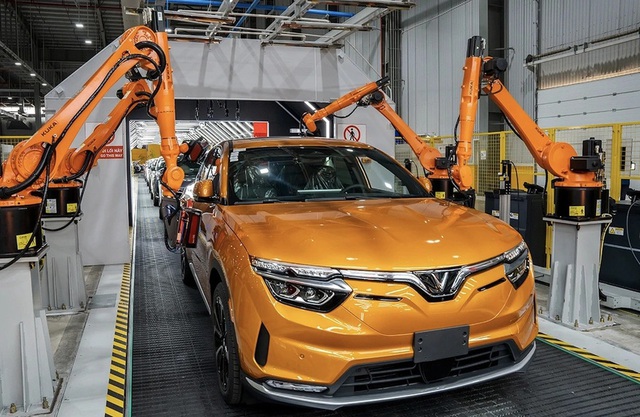 An electric car is manufactured at a VinFast facility in Vietnam. Photo: VinFast
The goal of achieving high-income status is not merely an economic target.
It reflects a broader aspiration about national standing, competitiveness, and Vietnam’s role in the global economic order.
Seventy years of global economic history offer a clear lesson: no country has become a major power by chance or by relying solely on low labor costs.
Japan emerged from World War II devastated.
South Korea in the 1960s was poorer than many African nations.
Germany was heavily destroyed and divided.
Singapore lacked natural resources and had only a small domestic market.
What these countries shared was not population size or natural endowments, but disciplined accumulation of internal capacity.
They undertook institutional reforms strong enough to build long-term investor confidence.
They pursued focused industrial strategies rather than spreading resources thinly.
They developed domestic enterprises capable of accumulating technology and leading value chains.
For Vietnam, nearly four decades after ‘Doi Moi’ reforms in 1986 have delivered remarkable progress.
From a closed economy, the country has become one of the most trade-open economies in the world.
Tens of millions have been lifted out of poverty. The middle class has expanded rapidly.
The private sector, once constrained in its role, now accounts for more than 96 percent of all enterprises and contributes roughly 40 percent of gross domestic product.
A new generation of entrepreneurs has matured in an environment of global integration and competition.
Yet the ambition of becoming a high-income country by 2045 requires a deeper look at the economy’s structure.
Enterprise scale remains modest. Investment in research and development (R&D) is still limited.
In global supply chains, domestic firms are concentrated largely in processing and assembly stages.
Export turnover is large, but value-added content remains comparatively modest.
Many observers argue that Vietnamese companies lack capital, technology, and highly skilled workers.
That assessment is valid, but incomplete.
The deeper issue lies in the structure of the development ecosystem.
When policy environments lack long-term predictability, businesses tend to prioritize short-term strategies.
When long-term capital markets remain underdeveloped, investment in technology and innovation becomes more difficult.
When linkages among government, universities, and enterprises are weak, the process of mastering homegrown technology slows.
In the absence of sufficiently strong leading firms, technology spillover effects across the economy are limited.
The result is a familiar cycle: short-term investment, low R&D spending, stagnant productivity, constrained internal accumulation, and limited upgrading within global value chains.
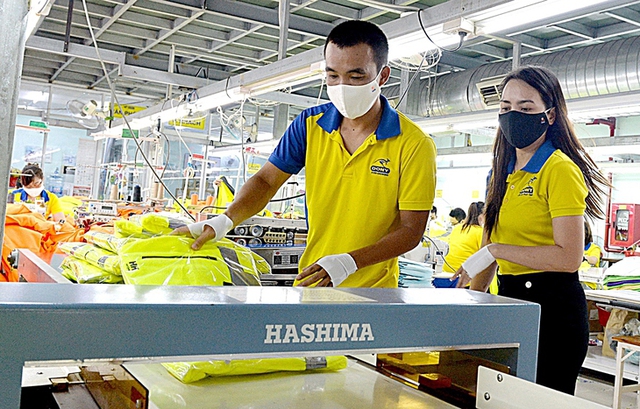 Workers produce garments at Dony Company in Ho Chi Minh City, Vietnam. Photo: Tu Trung / Tuoi Tre
Belief in 2045 requires breaking that cycle.
Confidence becomes a genuine advantage only when it is translated into capability.
The aspiration has a foundation if total factor productivity (TFP) becomes the principal driver of growth; if R&D spending rises to levels consistent with modern industrialization; if core technology enterprises emerge with the scale and strength to lead sectors and integrate deeply into regional value chains; if cooperation among the state, academia, and business is implemented through concrete projects with measurable outcomes; and if institutions foster a transparent, stable, and predictable environment for long-term investment.
The milestone of 2045 cannot be achieved through slogans.
It demands a structure of capability, a rise driven by internal strength.
The ambition of high-income status is not about running faster than others over a short distance, but about building resilience and endurance for the long journey.
If Vietnamese enterprises remain confined to processing and assembly roles, the country will remain at the lower end of the value spectrum.
If domestic firms master technology, build brands, and control higher-value segments, national standing will change.
If institutions not only ensure stability but also generate momentum, long-term investment confidence will be solidified.
Vietnam’s history shows that determined reform can bring rapid transformation.
The ‘Doi Moi’ reforms of 1986 were a turning point.
Reforms now under way could prove equally transformative if the country shifts from growth in breadth to growth in depth, from expansion of scale to upgrading of capability.
When internal strength is sufficiently accumulated, the vision for 2045 will no longer be a distant aspiration.
It will become a grounded confidence rooted in knowledge, in the mobilization of talent and resources, and in a nation prepared to enter a new era on the strength of its own capabilities.
HCMC, February 2026.
Mr. Pham Phu Ngoc Trai – Chairman of Packaging Recycling Organization (PRO) Vietnam

It’s early days for the technology, but many packaging leaders say they intend to use generative AI in the near future. Nestlé, Colgate-Palmolive and more peel back the curtain on their AI efforts. In Nestlé’s R&D department, a tool is identifying entirely new kinds of high-barrier packaging materials. It’s generative AI. A growing number of consumer […]


Brazilian researchers are moving fish-processing waste one step closer to a packaging-grade material. A team from the University of São Paulo (USP) and EMBRAPA Pecuária Sudeste has developed a transparent, flexible gelatin biofilm made from the skin of tambatinga, an Amazonian farmed hybrid fish. The concept is straightforward: upcycle collagen-rich skins into a biodegradable film that could […]

Ho Chi Minh City, January 30, 2026 – Packaging Recycling Organization Vietnam (PRO Vietnam) held the Workshop “PRO Vietnam Member Communication & Connection 2026”, officially establishing the focus of action for the next phase: shifting from raising awareness to demonstrating the effective operational performance of the collection – recycling system. A 2025 survey (conducted by […]

To express gratitude for the silent contributions that help Ho Chi Minh City maintains its urban sanitation, on January 24, Tuoi Tre Newspaper and PRO Vietnam organized the event “Tet Yeu Thuong” (Loving Tet), sending Tet warmth and well wishes to waste collectors. A waste collector hard at work, collecting household waste in HCMC narrow […]

A sustainable packaging advance for direct food contact, PureNil 0, is water-soluble and can be recycled with paper or safely flushed down the drain. Image: SmartSolve. SmartSolve introduced PureNil 0, a flexible packaging material that the company reports to be the world’s first 100% bio-based and flushable substrate. The fast-dissolving, water-soluble flexible packaging material is […]


