

Language
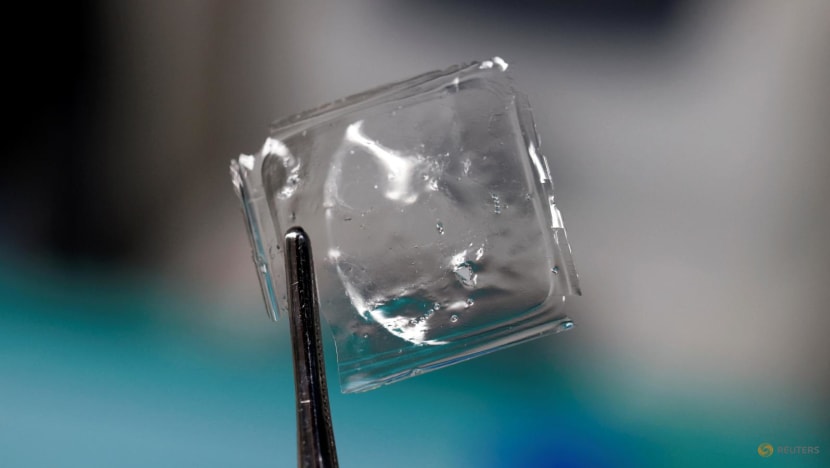
A researcher shows a sample of ocean-degradable plastic at the Center for Emergent Matter Science (CEMS) of Japanese research institution Riken in Wako, Saitama Prefecture, Japan, on May 27, 2025. (Photo: REUTERS/Manami Yamada)
WAKO, Japan – Researchers in Japan have developed a plastic that dissolves in seawater within hours, offering up a potential solution for a modern-day scourge polluting oceans and harming wildlife.
While scientists have long experimented with biodegradable plastics, researchers from the RIKEN Center for Emergent Matter Science and the University of Tokyo say their new material breaks down much more quickly and leaves no residual trace.
At a lab in Wako city near Tokyo, the team demonstrated a small piece of plastic vanishing in a container of salt water after it was stirred up for about an hour.
While the team has not yet detailed any plans for commercialisation, project lead Takuzo Aida said their research has attracted significant interest, including from those in the packaging sector.
Scientists worldwide are racing to develop innovative solutions to the growing plastic waste crisis, an effort championed by awareness campaigns such as World Environment Day taking place on Jun 5.
Plastic pollution is set to triple by 2040, the UN Environment Programme has predicted, adding 23-37 million metric tons of waste into the world’s oceans each year.
“Children cannot choose the planet they will live on. It is our duty as scientists to ensure that we leave them with best possible environment,” Aida said.
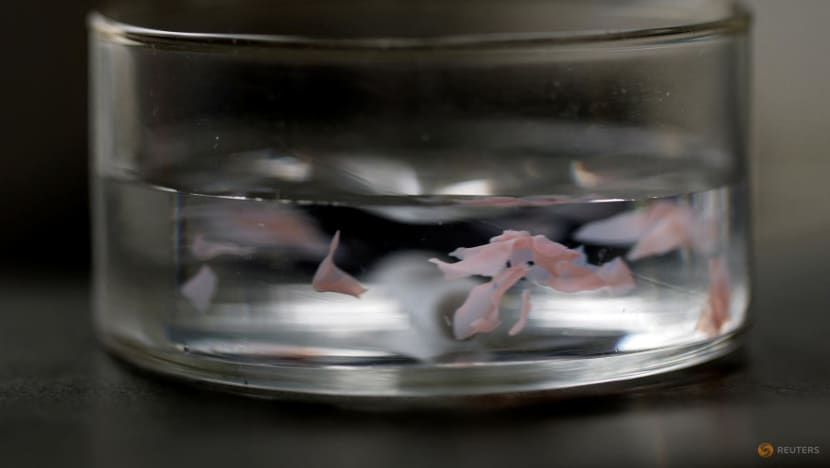
The sample of coloured ocean-degradable plastic being stirred and dissolved in saltywater is seen during a demonstration at the Center for Emergent Matter Science (CEMS) of Japanese research institution Riken in Wako, Saitama Prefecture, Japan, on May 27, 2025. (Photo: REUTERS/Manami Yamada)
Aida said the new material is as strong as petroleum-based plastics but breaks down into its original components when exposed to salt. Those components can then be further processed by naturally occurring bacteria, thereby avoiding generating microplastics that can harm aquatic life and enter the food chain.
As salt is also present in soil, a piece about 5cm in size disintegrates on land after over 200 hours, he added.
The material can be used like regular plastic when coated, and the team are focusing their current research on the best coating methods, Aida said. The plastic is non-toxic, non-flammable, and does not emit carbon dioxide, he added.
Source: CNA.

A sustainable packaging advance for direct food contact, PureNil 0, is water-soluble and can be recycled with paper or safely flushed down the drain. Image: SmartSolve. SmartSolve introduced PureNil 0, a flexible packaging material that the company reports to be the world’s first 100% bio-based and flushable substrate. The fast-dissolving, water-soluble flexible packaging material is […]


“Sustainable travel” might seem like a contradiction in terms, but it doesn’t have to be. Of course, any conference convening international experts will come with a carbon emissions impact, but before you head out, consider using these nine sustainable travel tips. From local waste bins to sustainable lodging habits, let’s look at ways we can […]

The PepsiCo Foundation funded the project ‘New Harvest: Sustainable Agriculture Initiative’, focusing on regenerative agriculture and climate change. On the sidelines of the bilateral negotiations on Vietnam-U.S. countertrade held from November 10–14 in Washington D.C., the PepsiCo Foundation, the Vietnam Partnership for Sustainable Agriculture (PSAV), the National Agricultural Extension Center (NAEC), and CARE signed a Memorandum […]
ABSTRACT Extended Producer Responsibility (EPR) represents a critical policy instrument for enhancing waste management systems. While Vietnam has initiated a transition from a discretionary to a mandatory EPR framework, significant challenges persist in the effective monitoring and evaluation of compliance by producers and importers; therefore, this study seeks to develop strategic policy recommendations aimed at […]

Discover the latest sustainable materials revolutionizing packaging circularity and improving environmental impact. Led by the “Reduce, Reuse, Recycle” mantra, the packaging industry is always in search of new ways to do better for the environment, whether it’s through the use of reduced reliance on eco-complicated materials, an increased adoption of recycled materials, or by exploring […]


