
1. What are plastic credits?
Plastic credits are measurable, verifiable, and transferable units representing a specific quantity of plastic that has been collected from the environment or recycled.[1]
Unlike carbon credits from plastic waste recycling operations, plastic credits are direct units, without the need through conversion calculations. The mechanism of action of plastic credits is almost identical to the Renewable Energy Certificate (REC).
2. The goal of plastic credits
A plastics credit is a certificate that can be bought by any public or private organisation. This organisation can use the plastic credit to take action and address plastic leakage along their supply chain, help finance projects that contribute to the fight against climate impacts and can help to reduce carbon emissions.[2]
Enterprises are aiming to collect, classify and recycle plastic waste in the production chain – supply of products using plastic and Plastic circulation is interested in social security, the environment and sustainable development are all suitable subjects to participate in the plastic credit project.
3. Background of promoting the implementation of plastic credit projects
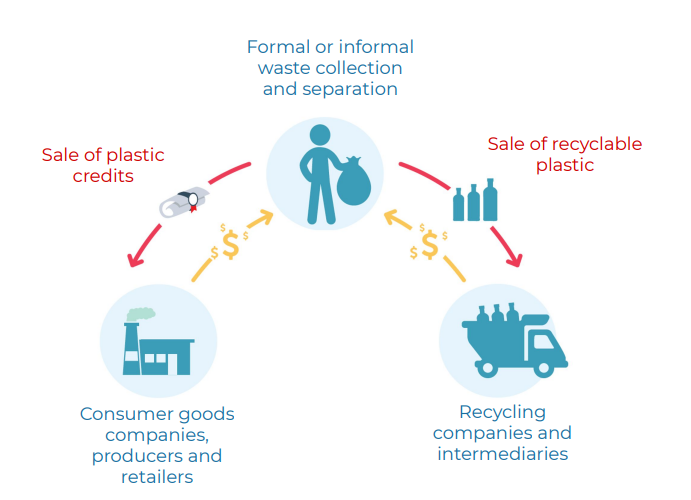
Dual benefits of taking plastic credits. Source: South Pole, 2021
4. Benefits from participating in plastic credit projects
In addition to promoting sustainable development, the purchase of plastic credits demonstrates the company’s responsibility for their plastic products.
The benefits from purchasing plastic credits:
For businesses that collect, treat and recycle plastic waste, they also have the opportunity to gain dual benefits from participating in the credit project. only plastic. Besides the sale of recyclable plastic waste products after classification (the main source of pre-existing revenue) to recycling companies and intermediaries, when participating in plastic credit projects , they can sell credits to manufacturing, retail and consumer goods companies use of plastic products in the supply chain of goods (additional revenue from plastic credit projects).
5. How to start a plastic credit project
Plastic credits are a new type of credit in Vietnam and around the world. By April 21th, 2022, there were only 7 projects on plastic credits on Verra, of which 5 projects are in the process of appraisal and verification, 1 project is being registered and appraised, 1 project has been registered.
In order to start the development and implementation of the plastic credit project, it is necessary to carry out a project evaluation according to Verra’s very strict eligibility criteria. Currently, VNEEC is collaborating with South Pole to find potential plastic waste recovery and recycling activities to build the project and connect potential domestic collaborations and international customers demanding to buy plastic credits.

It’s early days for the technology, but many packaging leaders say they intend to use generative AI in the near future. Nestlé, Colgate-Palmolive and more peel back the curtain on their AI efforts. In Nestlé’s R&D department, a tool is identifying entirely new kinds of high-barrier packaging materials. It’s generative AI. A growing number of consumer […]


Brazilian researchers are moving fish-processing waste one step closer to a packaging-grade material. A team from the University of São Paulo (USP) and EMBRAPA Pecuária Sudeste has developed a transparent, flexible gelatin biofilm made from the skin of tambatinga, an Amazonian farmed hybrid fish. The concept is straightforward: upcycle collagen-rich skins into a biodegradable film that could […]

The year 2045 — marking the 100th anniversary of the founding of Vietnam — is steadily becoming a strategic symbol in the nation’s development thinking. An electric car is manufactured at a VinFast facility in Vietnam. Photo: VinFast The goal of achieving high-income status is not merely an economic target. It reflects a broader aspiration […]

Ho Chi Minh City, January 30, 2026 – Packaging Recycling Organization Vietnam (PRO Vietnam) held the Workshop “PRO Vietnam Member Communication & Connection 2026”, officially establishing the focus of action for the next phase: shifting from raising awareness to demonstrating the effective operational performance of the collection – recycling system. A 2025 survey (conducted by […]

To express gratitude for the silent contributions that help Ho Chi Minh City maintains its urban sanitation, on January 24, Tuoi Tre Newspaper and PRO Vietnam organized the event “Tet Yeu Thuong” (Loving Tet), sending Tet warmth and well wishes to waste collectors. A waste collector hard at work, collecting household waste in HCMC narrow […]

