

A proper implementation framework is vital to achieve the main goal of ERP – motivating manufacturers and exporters to design products to be more environmentally friendly and easier to collect and recycle.
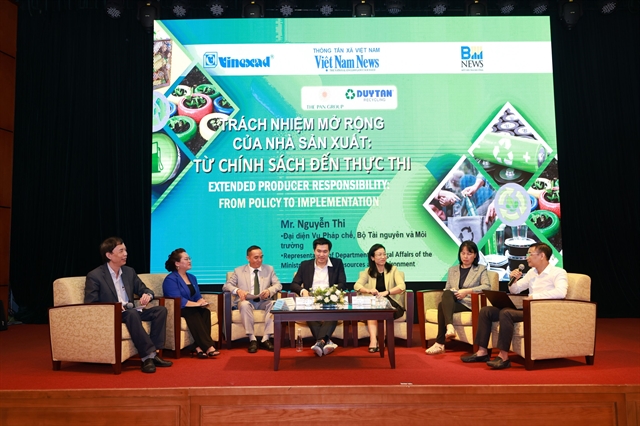
Panelists in a discussion session at the “EPR: From Policy to Implementation” seminar. — VNS Photo
HÀ NỘI — Detailed guidance on Extended Producer Responsibility (EPR) is expected to come out this month to facilitate the implementation, encouraging producers to have an active role in promoting a circular economy, according Nguyễn Thi from the Ministry of Natural Resources and Environment’s Department of Legal Affairs.
Speaking in a discussion session at the “EPR: From Policy to Implementation” seminar held by Việt Nam News and VINEXAD on Thursday within the framework of the 33rd Vietnam International Trade Fair (VIETNAM EXPO 2024) in Hà Nội, Thi said that a proper implementation framework is vital to achieve the main goal of ERP – motivating manufacturers and exporters to design products to be more environmentally friendly and easier to collect and recycle.
The Government’s Decree 08/2022/NĐ-CP detailing the implementation of the Law on Environment Protection is being amended and will be issued within this month, which will reduce compliance costs for enterprises.
He stressed that enterprises’ understanding and joining forces with the Government is important for successful EPR implementation in Việt Nam, the first in the region to embark on the EPR journey.
Emphasising the importance of EPR implementation in Việt Nam, Deputy Deneral Director of the Vietnam News Agency, Đoàn Thị Tuyết Nhung said: “This is a key task to achieve sustainable development for manufacturers and businesses, especially as Việt Nam has been struggling with severe impacts caused by pollution and climate change.”
“Implementing EPR will contribute to preserving resources for the future, reducing environmentally damaging waste, demonstrating businesses’ sense of social responsibility, and contributing to realising Việt Nam’s commitment at the COP26 to achieve net-zero emissions by 2050,” she stressed.
According to Thi from the environment ministry, long-awaited regulations on the rational cost of recycling per unit volume of products and packaging (Fs) will also be issued this month.
Fs, including costs of sorting, collection, transportation, product recycling, packing and management, is a critical factor for manufacturers and importers to calculate how much they have to pay, and consider whether to conduct their own recycling or pay to the Việt Nam Environmental Protection Fund (VEPF).
A circular on managing and use of VEPF is also being developed to ensure transparency and efficiency, Thi said.
According to Lê Anh, sustainability director of DUYTAN Recycling Company, Việt Nam is not the first country in the world to implement EPR but is making significant progress.
Stressing that ERP is a national competitive advantage, Anh said that owning green credits will help enterprises to expand their international reach. Green credit helps DUYTAN export around 60 per cent of its recycled products to the EU.
Greening is a must-go path, he added, citing an example that Việt Nam has lost a number of garment production orders due to delays in obtaining green credits.
Sorting and collecting is very important to the efficiency of recycling and the informal waste collectors are gaining attention with the EPR implementation. This labour force needs to be provided with support in terms of skills and social insurance policies to improve their incomes and lives, Anh said.
Chu Thi Kim Thanh, Chief Operating Officer of Vietnam Packaging Recycling Alliance (PRO Vietnam), said that EPR creates opportunities for the informal waste workers who play an important role in recycling.
Việt Nam also needs a reasonable Fs to make the recycling market operate on its own, she said. Fs should be developed for two types of products, those with recycling technology already established in Việt Nam and those without.
Fs should also consider eco-modulated fees with specific regulations for each product to motivate manufacturers to chain designs, she said, adding that a flexible mechanism should be applied to adjusting Fs.
According to Trịnh Thị Vân Giang, representative of the EuroCham Vietnam, said that manufacturers expect Fs to be issued soon and at reasonable level to encourage enterprises to do their own recycling rather than paying directly to the fund.
However, producers and exporters will need support from the Government and organisations to develop ideas for EPR implementation to create greater efficiency and impact.
Quách Thi Xuân, coordinator from Vietnam Zero Waste Alliance, said it is necessary to develop mandatory regulations on the use of recycled materials to create market for recycling businesses.
In addition, a clear roadmap for EPR implementation must be developed so that producers, exporters and recyclers can actively invest in recycling infrastructure, Xuân said.
There are still problems in EPR implementation such as inefficient collecting system, high recycling cost and lack of readiness in terms of technology and infrastructure, Sustainable Development and Innovation Director of the PAN Group, Nguyễn Trung Anh, said.
EPR is a factor to accelerate circular economy, but EPR is not simply to establish a system of waste collecting and recycling, but to change the thinking around production and consumption to ensure success, he added.
Việt Nam needs to have a roadmap for EPR implementation to ease the burden on manufacturers and exporters. In addition, EPR will require the sharing of the entire society, he said.
According to Thi, Việt Nam will apply a coefficient to Fs to encourage manufacturers and exporters to recycle and harmonise the benefits between manufacturers, exporters and recyclers.
Việt Nam also needs a separate system to operate EPR efficiently.
More attention will be paid to the informal waste collectors, estimated to total around 400,000 – 800,000, so that they will have better working conditions and develop to meet the rising recycling demand. — VNS.

It’s early days for the technology, but many packaging leaders say they intend to use generative AI in the near future. Nestlé, Colgate-Palmolive and more peel back the curtain on their AI efforts. In Nestlé’s R&D department, a tool is identifying entirely new kinds of high-barrier packaging materials. It’s generative AI. A growing number of consumer […]


Brazilian researchers are moving fish-processing waste one step closer to a packaging-grade material. A team from the University of São Paulo (USP) and EMBRAPA Pecuária Sudeste has developed a transparent, flexible gelatin biofilm made from the skin of tambatinga, an Amazonian farmed hybrid fish. The concept is straightforward: upcycle collagen-rich skins into a biodegradable film that could […]

The year 2045 — marking the 100th anniversary of the founding of Vietnam — is steadily becoming a strategic symbol in the nation’s development thinking. An electric car is manufactured at a VinFast facility in Vietnam. Photo: VinFast The goal of achieving high-income status is not merely an economic target. It reflects a broader aspiration […]

Ho Chi Minh City, January 30, 2026 – Packaging Recycling Organization Vietnam (PRO Vietnam) held the Workshop “PRO Vietnam Member Communication & Connection 2026”, officially establishing the focus of action for the next phase: shifting from raising awareness to demonstrating the effective operational performance of the collection – recycling system. A 2025 survey (conducted by […]

To express gratitude for the silent contributions that help Ho Chi Minh City maintains its urban sanitation, on January 24, Tuoi Tre Newspaper and PRO Vietnam organized the event “Tet Yeu Thuong” (Loving Tet), sending Tet warmth and well wishes to waste collectors. A waste collector hard at work, collecting household waste in HCMC narrow […]

