
Language
Starting from the fourth quarter of this year, Hanoi will pilot a program banning the use of single-use plastics at restaurants, hotels, eateries, and beverage outlets located within Ring Road 1. This initiative is part of the urgent tasks outlined in Directive No. 20, issued by the Prime Minister on July 12, aimed at preventing and addressing environmental pollution.
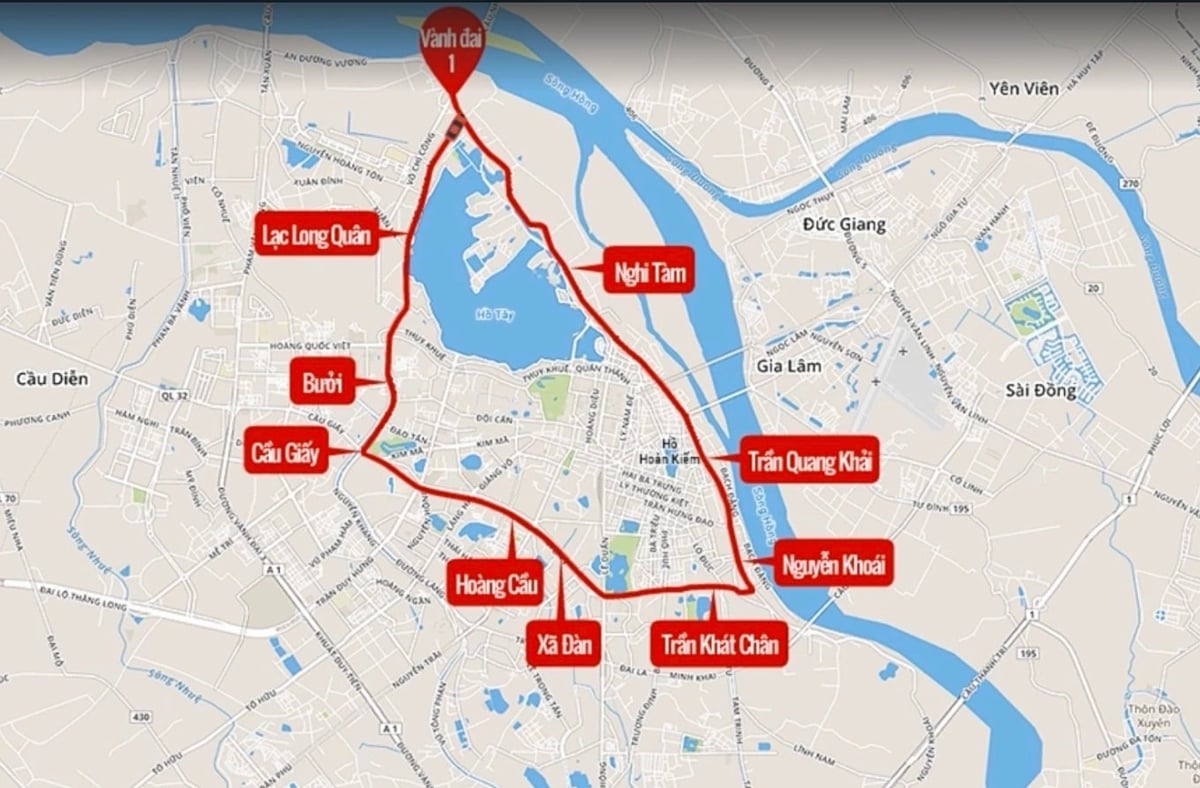
Image of Hanoi’s Ring Road 1. Graphic: Tran Tien Thanh.
The pilot program will begin in October and is expected to be expanded in the coming years. The city has shown strong determination to reduce plastic waste, as more than 1,400 tonnes of plastic waste are generated every day.
Two days before Directive No. 20 was issued, the Hanoi People’s Council also approved a resolution on measures to reduce plastic emissions in production, business, services, and daily activities across the city. This is regarded as a coordinated step by the municipal authorities to gradually cut plastic pollution at its source.
|
Effective Date |
Target Group |
Banned Products/Activities |
|
Jan 1, 2026 |
Hotels, tourist areas |
Single-use plastic items such as toothbrushes, razors, cotton swabs, shower caps, small sachets of toothpaste, shampoo, and shower gel |
|
Jan 1, 2027 |
Markets, convenience stores |
Free-of-charge plastic bags |
|
Jan 1, 2028 |
Government agencies |
Single-use plastics and non-biodegradable plastic packaging, including plastic bags and foam food containers |
|
Jan 1, 2031 |
Entire city |
Export/import of single-use plastics, non-biodegradable plastic packaging, and products containing microplastics |
According to Decree No. 08/2022, single-use plastic products include trays, food containers, bowls, cups, straws, and other items designed for one-time use, primarily made of plastic.
In addition, non-biodegradable plastic packaging is also restricted. These include types made from PE, PP, PS, PVC, and PET plastics, which can persist for a very long time in soil, water, and landfills.
Currently, plastic products are typically classified by codes from 1 to 7, corresponding to different characteristics and recyclability levels.
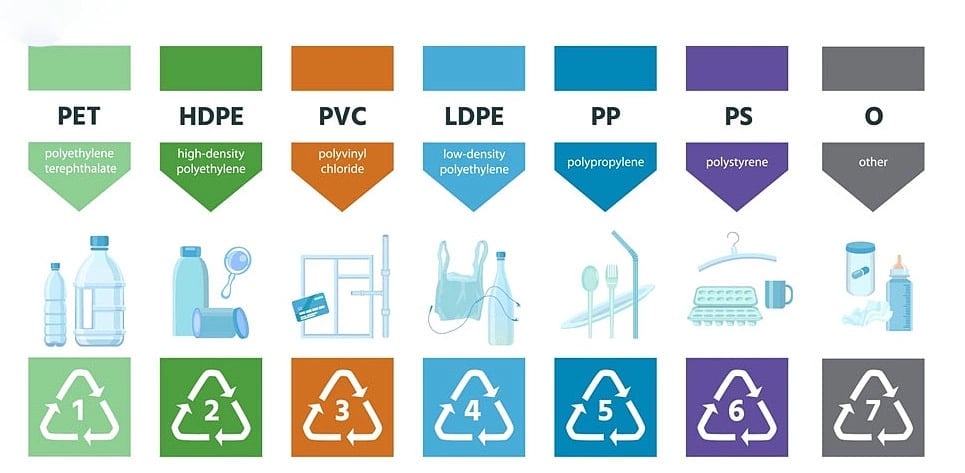
Plastic classification chart by resin code. Graphic with AI assistance (Bao Bao).
No. 1 (PET – Polyethylene Terephthalate): Commonly used in water and beverage bottles. It can be recycled multiple times into products such as T-shirts, blankets, and carpets.
No. 2 (HDPE – High-Density Polyethylene): Found in milk jugs and cooking oil bottles. It can be melted and mechanically recycled into household items and plastic trays.
No. 3 (PVC – Polyvinyl Chloride): Used in water pipes and phone cases. Recycling is very difficult because of numerous additives.
No. 4 (LDPE – Low-Density Polyethylene): Used for plastic bags and food wraps. Its recyclability is limited.
No. 5 (PP – Polypropylene): Found in food containers and bottle caps. It is relatively easy to recycle into items such as boxes and crates.
No. 6 (PS – Polystyrene): Used in foam food containers and plastic cups. It is very difficult to recycle and easily causes pollution.
No. 7 (Other – Mixed Plastics): Consists of mixed or composite plastics that are nearly impossible to recycle.
Not only in Hanoi, but many other localities are also implementing measures to reduce plastic waste. At coastal tourist destinations such as Cu Lao Cham (Da Nang) and Co To (Quang Ninh), regulations banning tourists from bringing plastic bags have been in place since 2019 and 2022 respectively. Six years ago, Ha Long Bay also introduced a complete ban on single-use plastic items such as cups, straws, and plastic bags. In May this year, a cruise ship there was suspended for seven days after allowing tourists to use single-use plastics.
Ho Chi Minh City is also stepping up efforts to reduce plastic waste, with the goal that by 2030, Thanh An Island Commune and tourist destinations in Can Gio will restrict the use of plastic bags and single-use plastics. In Da Nang, three years ago, Han Market launched a pilot “plastic bag–free market” model, where many vendors switched to paper bags and collected clean plastic bags for reuse.
At the national level, Decree No. 08/2022 stipulates that from 2025 onwards, shopping centers, supermarkets, hotels, and tourist areas will not be allowed to use or circulate single-use plastics and non-biodegradable plastic packaging such as plastic bags and foam containers. From January 1, 2026, Vietnam will reduce the production and import of small-sized non-biodegradable plastic bags. After 2030, the goal is to completely stop the production and import of single-use plastics, non-biodegradable plastic bags, and foam food containers.
This is part of Vietnam’s significant efforts to gradually realize its commitment to reducing environmental pollution and moving towards sustainable development.
Source: Khuong Trung – Agriculture and Environment Newspapers.

A sustainable packaging advance for direct food contact, PureNil 0, is water-soluble and can be recycled with paper or safely flushed down the drain. Image: SmartSolve. SmartSolve introduced PureNil 0, a flexible packaging material that the company reports to be the world’s first 100% bio-based and flushable substrate. The fast-dissolving, water-soluble flexible packaging material is […]


“Sustainable travel” might seem like a contradiction in terms, but it doesn’t have to be. Of course, any conference convening international experts will come with a carbon emissions impact, but before you head out, consider using these nine sustainable travel tips. From local waste bins to sustainable lodging habits, let’s look at ways we can […]

The PepsiCo Foundation funded the project ‘New Harvest: Sustainable Agriculture Initiative’, focusing on regenerative agriculture and climate change. On the sidelines of the bilateral negotiations on Vietnam-U.S. countertrade held from November 10–14 in Washington D.C., the PepsiCo Foundation, the Vietnam Partnership for Sustainable Agriculture (PSAV), the National Agricultural Extension Center (NAEC), and CARE signed a Memorandum […]
ABSTRACT Extended Producer Responsibility (EPR) represents a critical policy instrument for enhancing waste management systems. While Vietnam has initiated a transition from a discretionary to a mandatory EPR framework, significant challenges persist in the effective monitoring and evaluation of compliance by producers and importers; therefore, this study seeks to develop strategic policy recommendations aimed at […]

Discover the latest sustainable materials revolutionizing packaging circularity and improving environmental impact. Led by the “Reduce, Reuse, Recycle” mantra, the packaging industry is always in search of new ways to do better for the environment, whether it’s through the use of reduced reliance on eco-complicated materials, an increased adoption of recycled materials, or by exploring […]


